
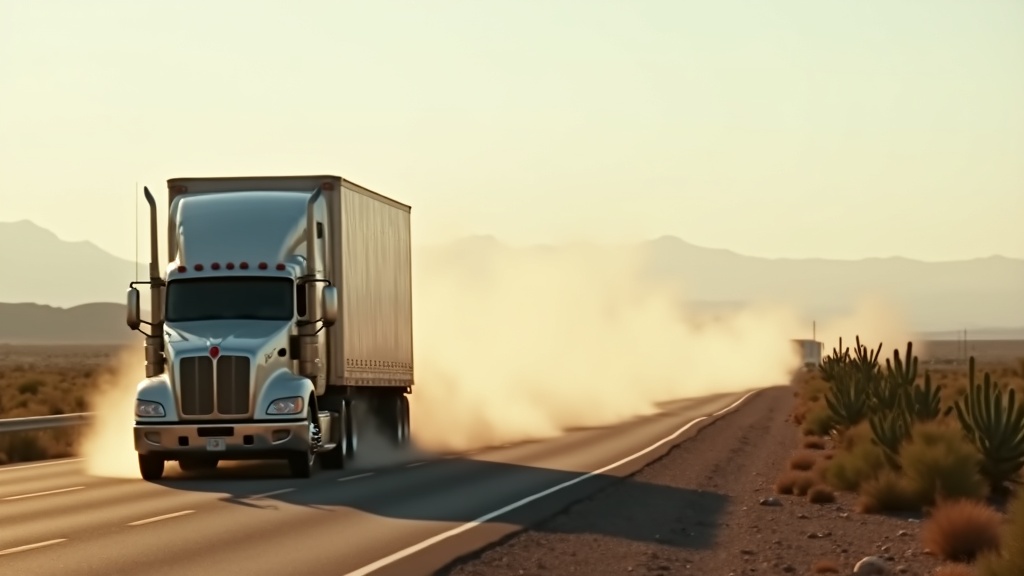
Phoenix Commercial Trucking Corridors: I-10, I-17, and Loop 101 Crash Risks
Phoenix sits at the intersection of major national freight routes, which means the Valley’s freeways carry some of the highest commercial truck volumes in the country. That concentration has consequences. Maricopa County accounts for approximately 40 percent of all commercial vehicle crashes in Arizona according to ADOT. If you were injured by a commercial truck on a Phoenix freeway, understanding the specific hazards of that corridor matters for building your case.
Why Phoenix’s Freeway Network Concentrates Truck Traffic in High-Risk Zones
Phoenix functions as a regional distribution hub for the entire Southwest. Major logistics operators have established warehouse and fulfillment facilities throughout the metro, particularly in Glendale, Goodyear, Tempe, and Chandler. Those facilities generate constant inbound and outbound freight movement on the freeways that connect them.
Commercial trucks behave differently than passenger vehicles in ways that create distinct crash risks: longer stopping distances, wider turning radii, higher center of gravity on loaded trailers, and dramatically greater impact energy in a collision. When those characteristics interact with Phoenix-specific conditions, including urban congestion, frequent construction zones, and tight merge geometries, the crash risk compounds.
Arizona recorded 121,107 total crashes in 2024 according to ADOT data. Commercial vehicles contributed a disproportionate share of serious-injury and fatal crashes relative to their share of total traffic.
I-10 — The Most Active Commercial Freight Corridor in the Phoenix Metro
Interstate 10 is the primary east-west commercial freight artery through the Phoenix metro and one of the busiest truck corridors in the nation. ADOT data shows 847 crashes in the Maricopa County segment of I-10 in 2024. The corridor moves freight connecting Los Angeles and the ports to Texas, the Gulf Coast, and points east, with Phoenix distribution stops along the way.
The stretch from the I-17 interchange west through Goodyear concentrates heavy truck traffic around major warehouse and logistics facilities. East of downtown, the transition through Tempe into Chandler adds urban congestion to high freight volume. Both conditions increase rear-end and sideswipe crash exposure for passenger vehicles traveling alongside 18-wheelers.
Tire blowouts on commercial trucks are a particular hazard on I-10. Federal regulations under 49 CFR Part 396 require carriers to conduct systematic vehicle inspections, maintain repair records, and keep commercial vehicles in safe operating condition. A tire failure caused by deferred maintenance or improper inflation is not an unavoidable accident: it is evidence of a carrier’s failure to meet its federal maintenance obligations.
I-17 — Steep Grades and Brake Failure Risk
Interstate 17 connects Phoenix to Flagstaff along a north-south corridor that includes some of the most demanding terrain for commercial vehicles anywhere in the state. The Black Canyon section north of Phoenix features significant elevation changes and sustained downhill grades. Loaded trucks descending those grades place extraordinary stress on braking systems.
Federal motor carrier safety standards require trucks to have functional brakes on every axle, properly adjusted and maintained. When a carrier skips brake inspections or delays repairs to keep a truck on the road, a steep descent on I-17 can turn a maintenance shortcut into a runaway vehicle. Brake failure crashes on mountain grades tend to be catastrophic: the vehicle’s speed and mass make collision avoidance nearly impossible.
Investigating an I-17 brake-related crash typically involves a forensic examination of the truck’s braking system by a certified commercial vehicle inspector, review of the carrier’s maintenance records and inspection logs, and analysis of the truck’s electronic data recorder (black box), which captures speed, brake application, and throttle position in the seconds before impact.
Loop 101 and Loop 202 — Distribution Traffic and Urban Congestion
The Loop 101 (traveling through sections known as the Pima, Price, and Agua Fria freeways) serves as the primary distribution loop for the north and east Valley. It connects major logistics hubs in Glendale, Tempe, and Scottsdale and carries significant daily commercial vehicle traffic generated by nearby distribution centers and retail supply chains.
The Loop 202, which spans the Red Mountain, South Mountain, and Santan freeways, has seen substantial growth in freight traffic as development expanded east and south through Gilbert, Chandler, and Mesa. The 202 is also a common bypass route for commercial vehicles avoiding the congested downtown I-10/I-17 interchange.
Both loops share a hazard profile: tight interchange geometry, frequent weave sections where trucks must merge or exit across lanes of moving traffic, and reduced sight lines compared to the wide-open desert stretches of I-10. Congestion forces trucks to brake and accelerate repeatedly, accelerating brake and tire wear. Merge conflicts between commercial vehicles and passenger cars are among the most common crash scenarios on these corridors.
Work zones add a compounding risk across all Phoenix corridors. Arizona law imposes enhanced penalties for violations in construction zones. Carriers are responsible for ensuring their drivers comply with reduced speed limits and lane restrictions in active construction areas.
If a commercial truck hit you on I-10, I-17, Loop 101, or Loop 202, the carrier’s liability may extend beyond the driver. Wood Injury Law offers a free case review. Call (480) 937-2116. No fee unless we win.
What if I was hit by a truck on a Phoenix freeway on-ramp or merge zone?
On-ramp and merge crashes involving commercial trucks raise a specific question: did the truck driver have adequate time and space to see you and adjust? Trucking companies and their insurers often attempt to assign fault to the merging vehicle, arguing it cut off the truck. An attorney can use traffic camera footage, witness statements, and the truck’s own data recorder to reconstruct who had the right of way and whether the driver could have taken any evasive action.
Who is responsible if a truck’s tire blew out and hit my car?
The carrier bears primary responsibility for maintaining its commercial vehicles in safe condition under 49 CFR Part 396. A tire blowout caused by worn tread, improper inflation, or deferred replacement is a maintenance failure, not random bad luck. In addition to the carrier, the company that performed maintenance on the truck and, in some cases, the tire manufacturer may share liability depending on the evidence.
Can the state or city be liable if a poorly maintained road contributed to the crash?
Potentially yes, but government liability claims follow different procedural rules than private claims. In Arizona, notice of claim requirements apply when suing a government entity, and the timelines are shorter than the standard two-year statute of limitations. If road conditions, signage failures, or construction zone design contributed to your crash, consulting an attorney promptly is important to preserve those claims.
How long do I have to file a claim after a truck accident in Phoenix?
Arizona’s personal injury statute of limitations is two years from the date of the crash under A.R.S. § 12-542. That deadline applies to claims against private carriers and drivers. If a government entity is involved, the claim timeline is shorter. Two years may sound long, but commercial truck cases require early evidence gathering: ELD records, maintenance logs, and black box data all have limited retention periods, and moving quickly protects your ability to build a complete case.
Phoenix freeway truck accidents involve multiple potentially liable parties. Wood Injury Law offers a free case review. Call (480) 937-2116. No fee unless we win.
This article is for general informational purposes only and does not constitute legal advice. Reading this content does not create an attorney-client relationship. Laws change; verify current statutes with a licensed Arizona attorney before relying on any information here.
Resumen en Español
Phoenix es uno de los centros de distribución de carga más importantes del suroeste de los Estados Unidos, lo que significa que sus autopistas concentran un volumen enorme de camiones comerciales. El Condado de Maricopa representa aproximadamente el 40% de todos los accidentes de vehículos comerciales en Arizona según datos del ADOT. En 2024, Arizona registró 121,107 accidentes totales en sus carreteras.
La Interestatal 10 es el corredor de carga más activo del área metropolitana de Phoenix, con 847 accidentes en el segmento de Maricopa County en 2024 según el ADOT. Conecta Los Ángeles con Texas y el sur del país, pasando por los grandes centros de distribución en Goodyear, Phoenix y Tempe. Los reventones de llantas en camiones comerciales son un peligro particular en esta ruta: los transportistas están obligados por la ley federal (49 CFR Parte 396) a mantener sus vehículos en condiciones seguras, y una falla de llanta por mantenimiento deficiente puede ser evidencia de negligencia.
La Interestatal 17 conecta Phoenix con Flagstaff a través de terreno montañoso con pendientes pronunciadas. Estas bajadas exigen mucho de los sistemas de frenos de los camiones cargados. Cuando una empresa transportista omite inspecciones o retrasa reparaciones, un camión en esa pendiente puede convertirse en un vehículo fuera de control.
El Loop 101 y el Loop 202 sirven como corredores de distribución para el norte, este y sur del Valle. El tráfico denso y los cruces complicados crean condiciones de riesgo adicionales, especialmente en zonas de fusión de carriles donde los camiones y los vehículos particulares deben compartir el espacio.
Si un camión comercial lo chocó en cualquiera de estas autopistas, la empresa transportista puede ser responsable además del conductor. Los registros del camión, los datos del GPS y los registros de mantenimiento son evidencia clave que puede desaparecer rápidamente. El plazo para presentar una demanda en Arizona es de dos años según A.R.S. § 12-542.
No espere para obtener ayuda legal. Llame a (480) 937-2116. Sin honorarios si no ganamos.