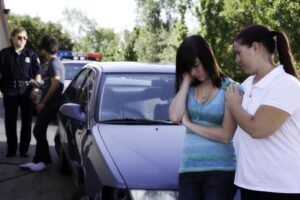
If you’ve been hit by a drunk driver in Arizona, your case is fundamentally different from a typical fender-bender or even a serious negligence case. The legal system recognizes impaired driving as something more than carelessness — and Arizona law provides for an additional category of damages designed specifically to punish that conduct.
This guide explains what punitive damages are, when they’re available, how much they typically run, and what evidence wins them.
What punitive damages are (and aren’t)
Personal injury cases generally award two categories of damages:
- Compensatory damages — money to make the victim whole. Medical bills past and future, lost wages, lost earning capacity, pain and suffering, loss of enjoyment of life.
- Punitive damages — money awarded on top of compensatory damages, specifically to punish the defendant and deter similar conduct in the future.
Punitive damages don’t restore anything to the victim. They’re a societal statement: “this conduct was so reckless that we’re adding a financial penalty beyond what your actual losses justify.” Insurance companies hate them — they’re often excluded from coverage, meaning the at-fault driver pays out of pocket. That’s part of the design.
Arizona’s standard for punitive damages
Under Arizona law, punitive damages require proof by clear and convincing evidence that the defendant acted with an “evil mind.” Arizona courts have interpreted this to include conduct that shows:
- Intent to injure, or
- Conscious pursuit of a course of conduct knowing it created a substantial risk of significant harm to others, or
- Spite, ill will, or actual malice
The leading Arizona Supreme Court case is Linthicum v. Nationwide Life Insurance, which established the “evil mind” requirement. Arizona courts have consistently held that driving while impaired qualifies. The choice to consume alcohol or drugs and then operate a vehicle is itself the conscious pursuit of a course of conduct creating substantial risk to others.
What evidence wins punitive damages in drunk-driving injury cases
Six categories of evidence we develop in drunk-driving injury cases:
- BAC level at time of crash. Higher BAC = stronger punitive case. Above 0.15 (Arizona’s “extreme drunk driving” threshold under A.R.S. § 28-1382) is particularly powerful evidence.
- Prior drunk-driving history. If the at-fault driver has prior drunk-driving offenses, the case for “conscious pursuit of risk” becomes overwhelming. Public record check.
- Behavior at the scene. Police reports document field sobriety test performance, statements made, demeanor. Body cam footage is often available via public records request.
- Witness testimony. Bartenders, friends who let them drive, anyone who saw the impairment beforehand. Dram shop liability (A.R.S. § 4-311) may even add additional defendants in cases where a bar over-served the driver.
- Toxicology beyond alcohol. Many drunk-driving injury cases involve combined substances. Toxicology reports often reveal more than just BAC — prescription medication, marijuana, controlled substances.
The compensatory + punitive math
Arizona doesn’t impose a strict statutory cap on punitive damages in drunk-driving injury cases. However, the U.S. Supreme Court has held in BMW v. Gore and State Farm v. Campbell that punitive damages should generally be no more than 9-10x compensatory damages. Most punitive awards fall in the 1x-4x range of compensatory.
Practical example structure (not a guarantee — every case is fact-specific):
- Medical bills (past + future): $80,000
- Lost wages: $25,000
- Pain and suffering: $100,000
- Compensatory subtotal: $205,000
- Punitive damages (in a strong drunk driving case): $200,000 to $800,000+
Bar rules prevent specific case-value quotes. Real numbers depend on injury severity, BAC level, prior drunk-driving history, insurance coverage availability, and venue.
The coverage problem in drunk driving punitive cases
Here’s where drunk-driving injury cases get complicated:
Many Arizona auto insurance policies exclude punitive damages from coverage. This means the insurance company pays the compensatory portion of the verdict, but the at-fault driver personally owes the punitive amount. If the driver has few assets, the punitive judgment may be largely uncollectable.
Strategy options when this happens:
- Identify additional defendants. Dram shop liability (the bar that over-served), social host liability in limited circumstances, employer liability if the driver was on the job.
- Pursue umbrella coverage. Some umbrella policies don’t have the punitive exclusion.
- Asset investigation. Some drivers have homes, retirement accounts, or business interests that punitive judgments can attach to.
- Your own UIM coverage. Your underinsured motorist coverage protects against the compensatory side, but typically not punitive.
The 2-year deadline still applies
Common mistakes after a drunk-driving crash
Mistake 2: Accepting a quick settlement that includes a release of all claims. Some insurance companies offer modest settlements early, hoping you’ll release punitive claims before they’re fully developed. Read every release carefully.
Mistake 3: Not requesting the police body cam footage promptly. Public records retention varies by department. Some footage is overwritten in 60-90 days. Request immediately.
Mistake 4: Settling without identifying all available coverage layers. Personal policy, umbrella, employer policy (if on-clock), dram shop, your own UM/UIM. Each layer is a separate negotiation.
Frequently asked questions
Q: The drunk driver was a minor. Different rules?
Possibly. Arizona’s social host liability laws and dram shop laws have specific rules for minors. The minor’s parents may have additional liability under common law theories. The case can include additional defendants beyond just the driver.
Q: I’m Maricopa County resident, the crash happened in Pima County. Where do I file?
Generally, you can file in either the county where the crash occurred or where the defendant resides. Venue strategy can affect jury composition and outcomes. An attorney evaluates this.
Q: The drunk driver died in the crash. Can I still recover?
Yes — the claim is against the driver’s estate. Their auto insurance remains available. If the estate has assets, those can be reached. Process is slightly different but the case proceeds.
Q: How much does it cost to pursue a drunk driving case?
Wood Injury Law handles drunk-driving injury cases on contingency — 33% if we recover, $0 if we don’t. All case costs (expert witnesses, records, depositions) are advanced by the firm. No upfront cost to you.
Q: Can I get punitive damages if I was also drinking?
Arizona applies pure comparative negligence under A.R.S. § 12-2505 — you can still recover even if partly at fault. However, your own impairment may reduce the compensatory portion and complicates the punitive analysis. Specific facts matter.
This is general information about Arizona personal injury and punitive damages law, not legal advice for your specific situation. Free, confidential case evaluations are available at Wood Injury Law.