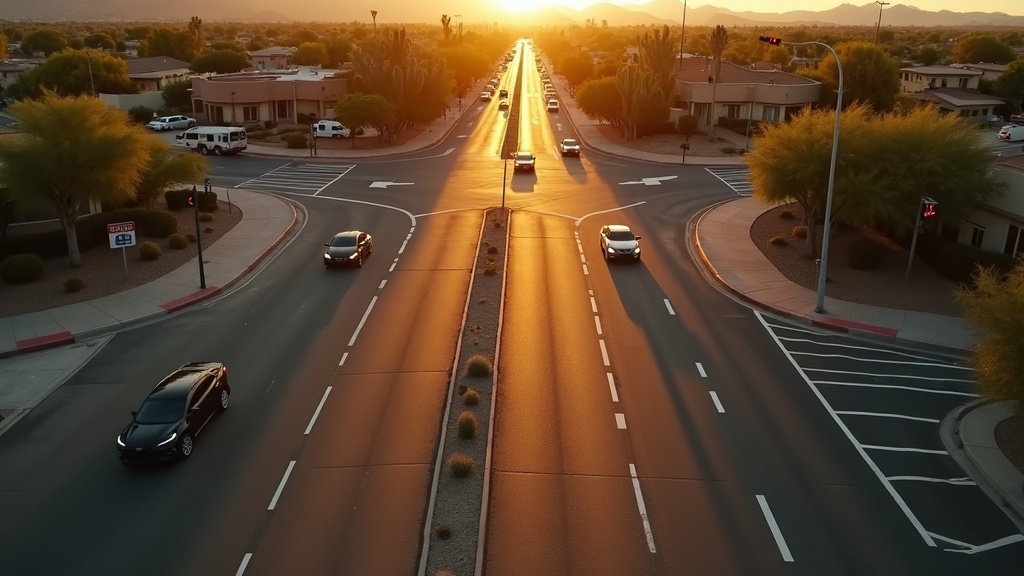
A pickup eases up to a stop sign off Southern Avenue, the driver’s head turned left, hunting for a gap in traffic while a woman steps into the crosswalk on his right. That moment is where two Arizona statutes earn their keep. ARS 28-773 requires a driver at a stop sign to stop, then yield to vehicles already in the intersection or close enough to be an immediate hazard. ARS 28-774 requires a driver entering a road from a driveway or private road to yield to all closely approaching traffic.
One thing worth clearing up first, because a lot of people land on these statute numbers expecting pedestrian law. Neither statute is a pedestrian statute. Arizona’s crosswalk and pedestrian rules live a few sections over, in ARS 28-792 through 28-794, and we will cover those here too, since real crashes rarely respect the chapter divisions.
What does ARS 28-773 require at a stop sign?
The statute has two commands stacked together. First, actually stop, the way the sign requires. Second, proceed with caution and yield the right-of-way to vehicles that are not required to stop and that are either inside the intersection already or approaching so closely that they pose an immediate hazard.
Notice what the law does not say. It does not say “stop, count to three, and then you have the right-of-way.” The stop is the beginning of the duty, not the end of it. A driver who stops fully, then pulls into the path of cross traffic, has still violated 28-773, and this is one of the most common fact patterns in East Valley intersection crashes.
The rolling stop is the other classic version. A driver slows to a creep, decides the gap is big enough, and rolls through. When the gap turns out not to be big enough, the driver has violated both halves of the statute at once, which makes the fault argument in a later injury claim fairly short.
What does ARS 28-774 say about driveways and private roads?
ARS 28-774 is a single sentence with a lot of reach. A driver about to enter or cross a highway from a private road or driveway must yield the right-of-way to all closely approaching vehicles on that highway. Every gas station exit, parking lot mouth, and residential driveway in Arizona sits under this rule.
The statute matters because driveway crashes generate a predictable dispute. The driver pulling out says the oncoming car “came out of nowhere” or was speeding. The law starts from a different place: the burden of yielding sits entirely on the person leaving the driveway. Speed of the oncoming car can shift some fault, but it does not erase the duty to yield.
Motorcyclists and cyclists are frequent victims of this exact violation, since a narrow profile is easier for a driveway-exiting driver to miss. The duty in the statute does not shrink because the approaching vehicle is small.
Which statutes actually cover pedestrians and crosswalks?
If you searched these statute numbers because a pedestrian was hit, the sections you want sit nearby. Three of them do most of the work in Arizona pedestrian cases:
- ARS 28-792 gives pedestrians the right-of-way in crosswalks, marked or unmarked, when no signal is operating, once the pedestrian is on the driver’s half of the road or approaching closely from the other half. It also bars pedestrians from leaving a curb so suddenly that a driver cannot yield, and it bars drivers from passing a car stopped at a crosswalk.
- ARS 28-793 covers crossing outside a crosswalk, what everyone calls jaywalking. A pedestrian crossing mid-block must yield to traffic, and between two signal-controlled intersections, crossing outside a marked crosswalk is not allowed at all.
- ARS 28-794 requires every driver to exercise due care to avoid hitting any pedestrian, no matter who has the right-of-way.
That last one deserves emphasis. A pedestrian who crossed in the wrong place has broken a rule, but the driver who saw them and did nothing has broken one too. Arizona law refuses to treat right-of-way as a license to hit people.
How does comparative fault change these cases?
Arizona is a pure comparative fault state under ARS 12-2505. A jury assigns each party a percentage of fault, and the injured person’s recovery is reduced by their own percentage rather than eliminated. Someone found 30 percent at fault still recovers 70 percent of their damages, and in Arizona even a person found 90 percent at fault can recover the remaining 10 percent.
This is where the driver statutes and the pedestrian statutes meet. Picture the mid-block crosser struck by a driver leaving a parking lot without looking right. The pedestrian violated 28-793, the driver violated 28-774 and 28-794, and the case becomes an argument over percentages rather than a simple yes or no. How those percentages get argued is really a question about how negligence works in Arizona, and the evidence usually matters more than the citation.
The exception worth knowing: comparative fault is not available to someone who intentionally or wantonly caused their own injury. Ordinary carelessness reduces recovery, it does not erase it.
What does a violation mean for an injury claim?
A citation under 28-773 or 28-774 does not decide a civil case by itself, but it comes close to deciding the negotiation. Insurance adjusters build their fault assessments around right-of-way, and a documented failure-to-yield violation gives the injured person’s side a strong opening position that the defense has to spend the whole claim trying to chip away.
What actually cements it is evidence: the officer’s diagram, witness statements, intersection camera or doorbell footage, vehicle damage patterns showing angle of impact. Fault fights in Arizona car accident claims are won with that file, and the file is easiest to build in the first weeks after the crash.
The deadline runs regardless of how strong the fault picture is. Arizona allows two years from the date of injury to file suit under ARS 12-542, with shorter notice deadlines when a government entity is involved, and our guide to the personal injury statute of limitations walks through the exceptions.
Frequently asked questions
Is a stop sign ticket enough to win my injury case?
No, but it helps considerably. The ticket is a traffic matter, and the injury claim is a separate civil matter where fault gets argued again. A citation for running the sign or failing to yield gives your side powerful evidence and shapes how the insurer values the claim, though the defense can still argue you share a percentage of fault.
Who yields when two drivers stop at the same time?
At an all-way stop, Arizona follows the familiar convention: the first to arrive goes first, and when two vehicles arrive together, the driver on the left yields to the driver on the right. In practice, crashes at all-way stops usually come down to witness accounts and damage angles rather than a clean answer about who arrived first.
Does a pedestrian in an unmarked crosswalk have the right-of-way?
Generally yes. An unmarked crosswalk exists at most intersections as the natural extension of the sidewalk, and ARS 28-792 treats it like a painted one when no signal is operating. Drivers must yield once the pedestrian is on their half of the road, though a pedestrian still cannot step out so suddenly that yielding becomes impossible.
What if the other driver’s insurer says I was partly at fault?
Expect that argument, because comparative fault is the standard defense move in right-of-way cases. Partial fault reduces your recovery by your percentage, so the insurer has a direct financial interest in inflating it. Do not accept their number. The percentage is negotiable, evidence-driven, and one of the main things a lawyer changes in a claim.
If a driver failed to yield and you got hurt, the fault fight has already started, with or without you. Wood Injury Law offers a free case review, and you pay no fee unless we win. Call (480) 937-2116 and let’s look at what the evidence says.
Free Case Review
Share a few details about what happened. There is no obligation to move forward.