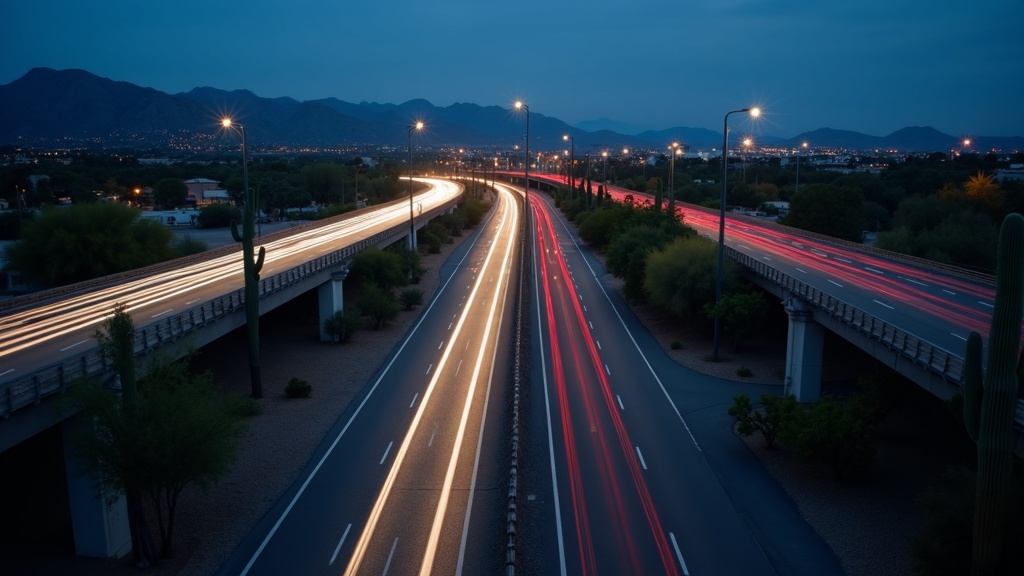
121,107. That is how many crashes ADOT counted on Arizona roads in 2024 in its annual Motor Vehicle Crash Facts report, and 1,228 people died in them. Mesa’s share of that ledger is not spread evenly across the city. It concentrates where the traffic concentrates: US-60, the Loop 202 Red Mountain freeway, and heavyweight arterials like Power Road and Country Club Drive. Those corridors are where Mesa drives, so they are where Mesa crashes.
What follows is not a ranked list of the city’s “most dangerous intersections.” Those lists circulate every year with crash counts that rarely survive a records request, and we would rather tell you something verifiable. What road design does reliably predict is the type of crash, and the type of crash predicts the injuries, the fault fight, and the shape of the claim that follows.
Why does the same road produce the same crash over and over?
Because crashes follow geometry. High-speed corridors produce longitudinal wrecks: rear-end chains when traffic compresses, sideswipes during lane changes and merges, and secondary collisions when the first wreck stops traffic cold. Intersections produce angle wrecks: the left-turn collision and the red-light T-bone, where one car strikes another broadside at the one spot where a door panel is all the protection a body gets.
The injuries split the same way. A corridor crash at freeway speed transfers enormous energy front to back, which is where whiplash, disc injuries, and head trauma from the rear come from. An intersection crash puts the impact inches from the occupant with almost nothing in between. Neither is worse in the abstract, but they get investigated differently, and insurers defend them differently.
What makes US-60 through Mesa so demanding?
The Superstition Freeway is the East Valley’s commuter spine, crossing the full width of Mesa with closely spaced interchanges at arterials like Country Club Drive, Gilbert Road, and Power Road. Close spacing means constant merging and weaving, and rush hour brings the classic shockwave: traffic ahead compresses, the third or fourth driver back reacts a half-second late, and a chain rear-end collects four cars in two seconds. Then everyone behind the wreck becomes a candidate for the secondary crash, which is often worse than the first one.
Chain collisions are legally messy in a way single impacts are not. Was the middle car pushed into the vehicle ahead, or did it strike first and get struck after? Event data recorders, damage sequencing, and fast witness work answer that question, and the answer moves real money, because Arizona splits liability by percentage of fault. In a four-car chain, the difference between being a pusher and being pushed can be your entire recovery. US-60 also carries steady commercial truck traffic toward the southeast Valley’s distribution hubs, and when an 18-wheeler joins the chain the case changes character entirely, as our truck accident pages explain.
Is Loop 202 Red Mountain any different?
Different rhythm, same physics. Red Mountain arcs along Mesa’s north and east edges with longer, sweeping segments and higher free-flow speeds than US-60’s stop-and-go core. Off-peak that means fewer crashes but faster ones: single-vehicle departures, lane-change sideswipes at speed, and high-energy rear-ends where fast traffic meets a slow surprise. The east-west stretches also point drivers directly into the sun at the worst hours of the day, an ordinary hazard that shows up in crash narratives far more often than people expect.
Speed is the multiplier in these cases. A following distance that works at 45 miles per hour guarantees an impact at 75, and injury severity climbs with the energy involved. Claims coming off Red Mountain tend to carry more serious injuries, and with them, higher stakes on every disputed fact in the file.
What about Power Road and Country Club Drive?
These are the other Mesa, the arterial Mesa, and the crash type changes with them. Power Road funnels freeway traffic from the US-60 ramps into dense retail frontage, so through-drivers doing 45 share lanes with drivers hunting for driveway entrances. Country Club Drive is the city’s old spine, running from the Loop 202 interchange down through some of the heaviest signal density in town. Multi-lane arterials with 40-plus speed limits, frequent driveways, and permissive left turns are exactly the environment where angle crashes live.
The signature wreck here is the left turn across traffic. A driver turns across two or three oncoming lanes, sees a gap in the near lane, and never sees the vehicle in the far lane, and the risk multiplies when that vehicle is a motorcycle, which is narrower, faster-looking than it reads, and hidden behind the very cars yielding to the turn. Fault in these collisions often looks obvious and often is, but insurers still argue speed, timing, and lane position, which is where the framework in our guide to negligence in Arizona stops being academic. Witnesses scatter fast at big intersections, so the claims that hold up are the ones where somebody collected names before the light changed twice.
How does the road change your claim?
A freeway pileup means multiple insurers, percentage-of-fault allocation, and event data pulled from several vehicles. An arterial T-bone means signal phases, witness credibility, and a causation fight over a side-impact injury. Either way, the road tells us where to look before the first phone call ends. These corridors are where a large share of our car accident work comes from, and our Mesa office sits in the middle of all of them, which is exactly how the title of this page earned itself.
Frequently asked questions
Who investigates a crash on US-60 or Loop 202 in Mesa?
Freeway crashes are usually handled by the Arizona Department of Public Safety, while Mesa police cover the city’s surface streets. The distinction matters for your claim because the investigating agency holds the crash report, scene photos, and officer camera footage, and records requests need to go to the right desk to come back quickly.
Does a traffic ticket decide who was at fault?
No, but it helps. A citation is the officer’s opinion, and the civil claim gets decided on the full evidence: statements, physical damage, data, and witnesses. Violating a traffic statute is strong proof of negligence, so a cited driver starts the negotiation in a hole, but insurers can and do contest fault even when their driver got the ticket.
How is fault sorted out in a chain-reaction rear-end?
By reconstructing the sequence. Event data recorders show each vehicle’s speed and braking, damage patterns show the order of impacts, and witness accounts fill the gaps. Arizona assigns each driver a percentage of fault, so a middle driver who was pushed into the car ahead can be fully innocent, while one who struck first shares liability.
Can the city or state be liable for a dangerous road?
Sometimes, when a signal malfunction, missing signage, or a design defect contributed to the crash. Those claims run on a brutal clock: ARS 12-821.01 requires a formal notice of claim against a public entity within 180 days, with suit filed within one year, so the government angle has to be evaluated early, not after other options fail.
If you were hurt on US-60, Loop 202, or any Mesa street, talk to a firm that knows these corridors before you talk to the adjuster. The case review is free, and you pay no fee unless we win. Call (480) 937-2116.
Free Case Review
Share a few details about what happened. There is no obligation to move forward.