Tuesday night, red light, and the truck behind you never brakes. Metal folds, your head snaps forward, and by the time your eyes find the mirror he is already backing up, swinging around your bumper, and driving off. No plate, no chance to read one, just taillights. Here is what to do: call 911 from the scene, record everything you remember before it fades, get medical care the same day, and then notify your own insurance company, because in Arizona your uninsured motorist coverage exists for exactly this moment.
Hit-and-run cases feel hopeless in a way ordinary crashes do not, because the person who caused everything is absent. They are not hopeless. Arizona built a criminal statute to punish the driver and an insurance framework to compensate you whether or not that driver is ever found, and both systems work better the sooner the claim starts.
Why does the first hour decide these cases?
Because everything that identifies the driver decays fast. The paint transfer on your rear quarter panel, the headlight fragments in the road, the neighbor’s doorbell camera that overwrites itself in days, the witness who saw a silver sedan turn south but will not remember the street by Friday. Police can only work with what gets captured, and insurers apply extra scrutiny to claims involving an unidentified driver, so the record you build in the first hour carries the entire case.
At the scene, in this order:
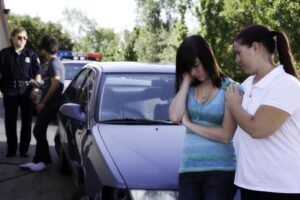
- Call 911, even if the crash looks minor. The police report is the spine of a hit-and-run claim, and many policies expect prompt notification to law enforcement when the driver is unknown.
- Record a voice memo with everything you remember: vehicle color, type, damage, direction of travel, any fragment of the plate, anything about the driver.
- Photograph your car, the debris field, the intersection, and any paint transfer before the road gets swept.
- Collect names and numbers from every witness, including people who only heard the impact.
- Look for cameras: houses with video doorbells, businesses with parking lot views, any parked car that might be running a dashcam.
The pieces the fleeing car left behind are worth more than most people think. Headlight housings and trim parts carry markings that can identify a make, model, and production range, which turns “a dark SUV” into a short list. In our cases we send preservation letters to nearby homes and businesses quickly, because most camera systems overwrite themselves on a cycle measured in days, and footage that exists on Tuesday is often gone by the weekend.
Why is your own policy the real path to recovery?
When the driver is never identified, the claim does not die, it changes address. Arizona treats an unidentified hit-and-run driver as an uninsured motorist, which means your own uninsured motorist (UM) coverage steps into the shoes of the insurance that driver should have had. UM pays for medical bills, lost income, and pain and suffering, the same categories a liability claim against the driver would have covered.
Arizona takes this coverage seriously. Under ARS 20-259.01, every auto insurer in the state must offer UM coverage, and it can only be left off your policy if you rejected it in writing. Plenty of people carry it without remembering they do, so pull your declarations page before assuming you have nothing to work with. Medical payments coverage and your health insurance fill in around it, the same layered structure our Arizona car accident practice untangles every week.
Two cautions. UM policies impose their own conditions on claims involving unidentified drivers, commonly prompt police reporting, and some ask for corroboration such as physical contact damage or an independent witness, so read your policy or have someone read it for you. And remember that the adjuster on a UM claim works for a company that keeps more money when you recover less. The claim is against your own insurer, but it is still an adversarial negotiation, and it deserves the same documentation and the same skepticism as any other injury claim.
What happens when the police do find the driver?
Two tracks open at once. The civil track is a normal injury claim against the driver and whatever liability insurance they carried. Fleeing drivers are disproportionately people with something to hide, no insurance, a suspended license, or impairment, and a driver who ran because they had been drinking faces the same civil exposure we cover in our guide to being hit by a drunk driver in Arizona. If the driver turns out to be uninsured after all, your UM coverage remains the backstop, so finding the driver does not mean losing that option.
The criminal track runs on its own schedule and belongs to the state. Arizona law required that driver to stop, exchange information, and render aid, and leaving the scene of an injury crash is a felony under ARS 28-661, with license revocation that runs three years for an injury crash, five years when someone suffered serious physical injury, and ten years after a death. You do not control the prosecution, but it helps the civil side: convictions and restitution orders create leverage, and the criminal file often contains witness statements and camera footage you could never have gathered alone.
How long do you have to act?
Several clocks run at once, and they are different lengths. A claim against the driver, if identified, follows the two-year personal injury deadline in ARS 12-542, covered in our statute of limitations guide. The UM claim runs on its own statute: ARS 12-555 requires written notice to your insurer of your intent to pursue a UM claim within three years of the accident, and your policy layers its own notice requirements on top of that, which can be far shorter in practice.
None of those is the real deadline. The real deadline is however long the doorbell footage on your street survives, and that one is measured in days, not years.
Frequently asked questions
Is a hit and run a felony in Arizona?
When someone is hurt, yes. Under ARS 28-661, leaving the scene of an injury crash is a class 5 felony, rising to a class 3 felony when the crash involved death or serious physical injury, and to a class 2 felony when the fleeing driver also caused that crash. A damage-only hit-and-run is a class 1 misdemeanor under ARS 28-662.
Will a hit-and-run claim affect my insurance rates?
Arizona law protects you here. Under ARS 20-263, an insurer may not raise your premium because of an accident you did not cause or significantly contribute to, and getting struck by a fleeing driver is about as clear an example as exists. If your premium does rise after an accident, the insurer must tell you the reason for the increase.
What should I do right after a hit and run?
Do not chase the driver. Get to safety, call 911, and capture what you remember immediately, because details like plate fragments and vehicle color fade within minutes. Photograph the scene and your car, collect witness contacts, get medical care the same day, and notify your own insurer promptly to protect your uninsured motorist claim.
Can I recover if the driver is never found?
Yes, if you carry uninsured motorist coverage, which Arizona insurers must offer and which is only absent if you rejected it in writing. UM coverage compensates you as though the unidentified driver had carried insurance, paying medical costs, lost wages, and pain and suffering. Without UM, options narrow to medical payments coverage and health insurance.
If a driver hit you and disappeared, the clock on the evidence is already running. Talk to us before the footage is gone. The case review is free, and you pay no fee unless we win. Call (480) 937-2116.
Free Case Review
Share a few details about what happened. There is no obligation to move forward.