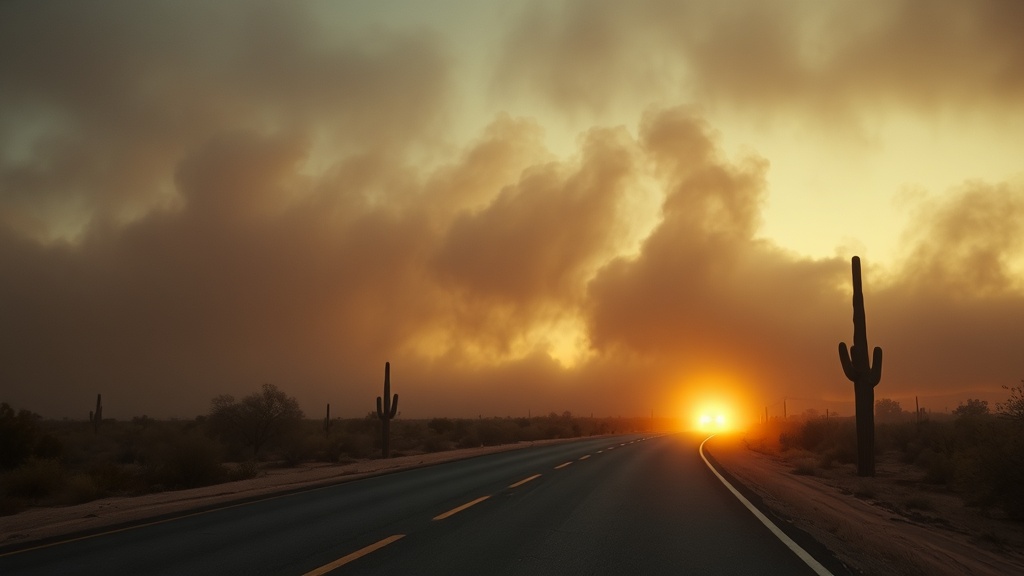
Monsoon season in Arizona — typically mid-June through September — produces some of the most dangerous driving conditions in the state. Dust storms (haboobs) can drop visibility to under 50 feet in seconds. Flash floods turn city streets into rivers. Microbursts produce sudden 70+ mph winds. When a crash happens during these conditions, liability questions get complicated fast.
This guide walks through how Arizona courts handle monsoon-condition personal injury cases.
The “act of God” defense — and why it usually fails
The first thing most defendants try in a weather-related crash: “It was an act of God. I couldn’t have prevented it.” Arizona courts have heard this argument for decades and generally reject it for routine weather events.
The legal test: an act of God defense only applies when:
- The weather event was so extreme it was unforeseeable, and
- The defendant’s negligence did not contribute to the harm
Monsoon storms in Arizona fail prong 1. Monsoon season is annual, predictable, and well-publicized. Every driver in the state is on notice that mid-June through September brings dust storms, flash floods, and severe weather. Arizona Department of Transportation issues warnings constantly. The conditions themselves are not unforeseeable — they’re expected.
Arizona courts therefore require drivers to operate “reasonably under the conditions then existing.” Reasonable monsoon driving includes:
- Pulling over when visibility drops below safe limits (“Pull Aside, Stay Alive” — Arizona’s dust storm safety campaign)
- Reducing speed appropriately for road conditions
- Maintaining greater following distance
- Using headlights
- Not driving through standing water of unknown depth
A driver who fails to do these things and causes a crash isn’t protected by the weather. The weather is a known condition they had a duty to drive reasonably within.
The specific Arizona rule: “Reasonable driver under conditions then existing”
This standard appears throughout Arizona case law and traffic code. Arizona Revised Statutes § 28-701 explicitly requires drivers to control their vehicle’s speed “having due regard to the actual and potential hazards then existing.” A driver going 65 mph through a dust storm is violating this even if 65 was the posted limit. The duty is to drive reasonably for the conditions, not for the speed limit.
This is the legal hook for most monsoon-condition liability cases. The defendant’s duty is the same as on a clear day — to operate the vehicle with reasonable care. Weather just changes what reasonable care looks like.
Common monsoon-condition crash scenarios
Dust storm / haboob
The Phoenix metro area gets several major dust storms per year. Visibility drops to under 50 feet, sometimes near zero. Arizona’s “Pull Aside, Stay Alive” campaign specifically directs drivers to exit the roadway, turn off headlights and brake lights, and wait out the storm. Drivers who continue at speed through a haboob are typically found negligent.
Pile-ups are common. Liability is often distributed across multiple drivers based on each one’s relative speed, following distance, and reaction to the conditions.
Flash flooding
Arizona’s “Stupid Motorist Law” (A.R.S. § 28-910) allows the state to recover the cost of emergency response from drivers who go around barricades into flooded roadways. In civil personal injury cases, this kind of conduct is strong evidence of negligence.
Common scenario: driver enters a flooded intersection or wash, gets stuck or swept, causing a chain reaction that injures others. The driver who entered the water is typically liable.
Microbursts and high winds
Sudden high winds can blow vehicles out of their lane, knock over trailers, and cause loss of control. Liability depends on whether the wind was foreseeable (current weather advisory in effect?) and whether the driver was operating reasonably for conditions.
For commercial trucks especially, high-wind conditions trigger heightened duties. FMCSA regulations require trucker awareness of weather conditions on routes.
Hydroplaning on rain-slick highways
The Phoenix-area highways accumulate oil during dry weather. The first rainstorm produces dramatically slick conditions for a short period before the oil washes away. Drivers should know this and reduce speed accordingly. Failure to do so is negligence.
Comparative fault in monsoon cases
Arizona’s pure comparative negligence rule under A.R.S. § 12-2505 frequently applies in weather cases. Multiple drivers may share fault percentages:
- Driver A enters the dust storm at 65 mph (poor judgment given conditions) — finds at 40% fault
- Driver B was already stopped on the shoulder properly but with brake lights on (violates pull-aside guidance) — finds at 10% fault
- Driver C, who slammed into B then A, was following too closely — finds at 50% fault
Each driver can recover from the others proportionally. This is why monsoon multi-vehicle crashes often involve multiple cross-claims among defendants.
Evidence that wins monsoon cases
- Weather data. National Weather Service archives provide minute-by-minute conditions for the crash location. ASOS station data near major Arizona roadways is publicly available.
- Active weather advisories at the time. Was there a dust storm warning in effect? A flash flood watch? A high wind advisory?
- Defendant’s vehicle dynamics. Black box data from modern vehicles records speed, brake input, steering input. Subpoena rights are routine.
- Witness statements. What did other drivers see? How were they reacting to conditions?
- News coverage. Local TV and news outlets often have footage of monsoon events at specific times and locations.
- Defendant’s prior knowledge of conditions. Texts, social media posts, dashcam, GPS logs may show defendant knew about the weather.
Commercial vehicles get less leeway
Commercial truck operators have heightened duties under FMCSA regulations to monitor weather conditions on their routes. A truck driver who continues through a known dust storm or flooded area, or who fails to plan around forecasted weather, may face additional liability beyond standard negligence — including negligent entrustment claims against the trucking company.
Arizona-specific procedural notes
- Standard 2-year statute of limitations under A.R.S. § 12-542
- 180-day notice if government defendant under A.R.S. § 12-821.01 (e.g., if ADOT failed to barricade a flooded roadway)
- Pure comparative negligence under A.R.S. § 12-2505
- Stupid Motorist Law A.R.S. § 28-910 — government can recover rescue costs from drivers who go around barricades
Common mistakes after a monsoon-condition crash
Mistake 1: Accepting the “act of God” framing from the other driver’s insurance. The defense almost never works for monsoon events in Arizona. Don’t be talked out of pursuing a case.
Mistake 2: Not preserving weather data immediately. NWS data is available but specific advisories and station data should be downloaded and saved promptly.
Mistake 3: Settling property damage before injury claim is fully evaluated. Some adjusters use weather as leverage to push quick settlements before symptoms develop.
Mistake 4: Assuming you can’t recover if you were also driving in the conditions. Pure comparative negligence in Arizona means you can recover even if partly at fault.
Frequently asked questions
Q: I was hit by another driver during a dust storm. Both of us were driving “normally” until visibility dropped. Whose fault is it?
Depends on how each driver responded once visibility dropped. The driver who failed to slow down, pull over, or stop has the greater fault share. The detailed timeline matters.
Q: I drove around a “Road Closed” barricade because the water didn’t look deep, and another car hit me. Does the Stupid Motorist Law affect my case?
The state can recover rescue costs from you (Stupid Motorist Law). In the civil case, your conduct will be strong evidence of comparative fault. But you may still recover something if the other driver was also negligent.
Q: My car was blown off the road by a microburst. Do I have a case against anyone?
Possibly. If you can identify another driver whose conduct contributed (failed to maintain lane, was speeding for conditions, etc.), they may share liability. If it was purely natural force with no human contribution, it’s hard to make a case.
Q: I’m a commercial truck driver who got hit in a dust storm while parked properly on the shoulder. Different rules?
You’re owed the same duty of reasonable care from other drivers. Being properly parked actually helps your case — you were following the right safety practice. The driver who hit you is likely negligent.
Q: How does monsoon-condition insurance coverage work?
Standard liability coverage applies. No special “weather exclusion” exists in Arizona auto policies. The at-fault driver’s insurance pays in the usual layered fashion.
This is general information about Arizona personal injury law and weather-related crashes, not legal advice for your specific situation. Free, confidential case evaluations are available at Wood Injury Law.