
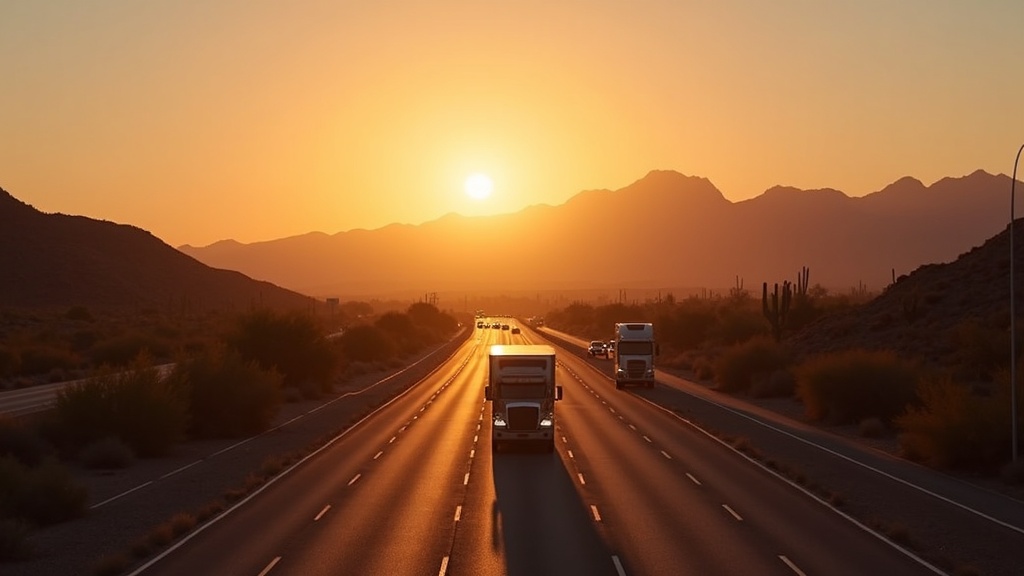
Why Tucson Truck Cases Are a Different Legal Animal
An 80,000-pound semi-truck colliding with a passenger vehicle on I-10 through Tucson is not a bigger car accident. Federal FMCSR rules govern. Carriers carry seven-figure policies. National trucking insurers dispatch rapid-response investigators within hours of a crash. And the evidence that decides the case — electronic logs, ECM data, dispatch communications, maintenance records — begins disappearing within days unless a spoliation letter goes out.
This page covers what specifically governs Tucson commercial truck cases: the FMCSR rules that shift the leverage, the I-10 and I-19 corridors where crashes concentrate, the time-sensitive evidence at risk.
The Federal Rules That Govern Every Commercial Truck on Tucson Highways
Commercial trucks operating in interstate commerce are subject to the Federal Motor Carrier Safety Regulations (FMCSR) at 49 CFR Parts 350-399. Violations are direct evidence of negligence — substantially stronger than the standard duty-of-care framework.
49 CFR 395 — Hours of Service
Property-carrying drivers may not drive more than 11 hours after 10 consecutive hours off duty. May not drive after the 14th consecutive hour on duty. Must take a 30-minute break before driving beyond 8 consecutive hours. Violations are recorded by electronic logging devices (ELDs) installed in the cab. Retained for six months under federal rules; lawfully purged after.
| Regulation | What it requires | Why it matters in Tucson |
|---|---|---|
| 49 CFR 395 | Hours-of-service + ELD compliance | I-10 long-haul fatigue from El Paso to Phoenix is documented pattern |
| 49 CFR 391 | Driver qualifications + medical fitness | Disqualifying conditions on file = company knew, didn’t act |
| 49 CFR 392 | Driving operations, speed + weather | Monsoon dust storms (haboobs) on I-10 between Phoenix and Tucson; failure to slow is violation |
| 49 CFR 393 | Vehicle parts + accessories | Desert heat accelerates tire and brake failures |
| 49 CFR 396 | Inspection + maintenance records | Pre-trip inspection logs become key evidence |
| 49 CFR 382 | Drug + alcohol testing | Post-accident testing required; failure to test is federal violation |
The Tucson Corridors Where This Case Type Concentrates
I-10 corridor through Tucson
The principal east-west freight corridor connecting Phoenix to Tucson to El Paso. Heavy commercial truck volume year-round. The Tucson metro section through downtown and to the I-19 system interchange carries the highest density of crashes in the region.
I-19 corridor (Tucson to Nogales)
North-south freight corridor connecting Tucson to the Mexico border. Heavy commercial truck traffic mixed with commuter traffic, particularly through the Sahuarita and Green Valley areas.
I-10 east of Tucson to Benson and Willcox
Long sight lines, high speed, remote. When crashes happen here they tend to be severe, and emergency response distances are significant.
Tanque Verde Road and Catalina Highway
Mountain access routes attract recreational traffic. Drivers crossing centerlines on curves is a recurring pattern, particularly on Catalina Highway / Mount Lemmon Road.
Speedway, Broadway, and Grant Road arterials
Major east-west surface streets through Tucson. Signal violations and lane-change crashes recur at the I-10 interchanges.
Tucson truck evidence disappears fast
ELD records, vehicle maintenance logs, ECM data, dispatch communications, and dashcam footage all have retention windows measured in days to months. A spoliation letter must reach the trucking company within 7-14 days. After that window, critical evidence can be lawfully destroyed.
Common Causes of Tucson Truck Accidents
- Driver fatigue + hours-of-service violations (long I-10 hauls)
- Distracted driving (cell phone use, regulated under 49 CFR 392.82)
- Inadequate driver training or unqualified drivers
- Equipment failure + maintenance violations (desert heat cycles)
- Improper loading + unsecured cargo
- Drug or alcohol impairment
- Weather: monsoon dust storms, sudden heavy rain
- Aggressive driving + speeding
Who Can Be Held Liable in a Tucson Truck Case
- The truck driver
- The trucking company (motor carrier) — vicarious + direct liability
- The freight broker
- The cargo loader or shipper
- The truck or parts manufacturer
- The maintenance contractor
Damages You Can Recover
- Past and future medical expenses
- Lost income and future earning capacity
- Pain and suffering
- Property damage
- Disfigurement and permanent impairment
- Loss of consortium
- Punitive damages
- Wrongful death damages under ARS 12-611 et seq.
ARS 12-542 — Two-Year Statute of Limitations
Tucson truck accident personal injury claims must be filed within two years. Wrongful death cases follow the same window. Government claims under ARS 12-821.01 require notice within 180 days.
The First Seven Days After a Tucson Truck Crash
- Get medical evaluation immediately.
- Photograph the scene if you safely can.
- Get the crash report from Tucson Police or DPS.
- Do not give a recorded statement to the trucking insurer.
- Contact a Tucson truck accident lawyer within 7 days.
- Keep a daily condition journal.
- Preserve every medical bill and out-of-pocket expense.
Why Wood Injury Law for Your Tucson Truck Case
- Fees explained up front, in writing.
- Free initial consultation.
- Direct attorney attention from Josh Wood.
- Federal regulatory experience.
- Statewide Arizona focus including Tucson and Pima County.
Frequently Asked Questions
How long do I have to file a Tucson truck accident lawsuit?
What is the minimum insurance a commercial truck must carry?
The truck driver was an independent contractor. Can I still sue the carrier?
What is a spoliation letter?
The carrier’s insurance called within 24 hours. Should I talk?
I was partially at fault. Can I still recover?
How long does a Tucson truck case typically take?
What does it cost to hire a Tucson truck accident lawyer?
Hit by a Commercial Truck in Tucson?
The trucking company’s defense is already building. The spoliation letter has to go out in the next 7 days. Free consultation, and no obligation to go further.