
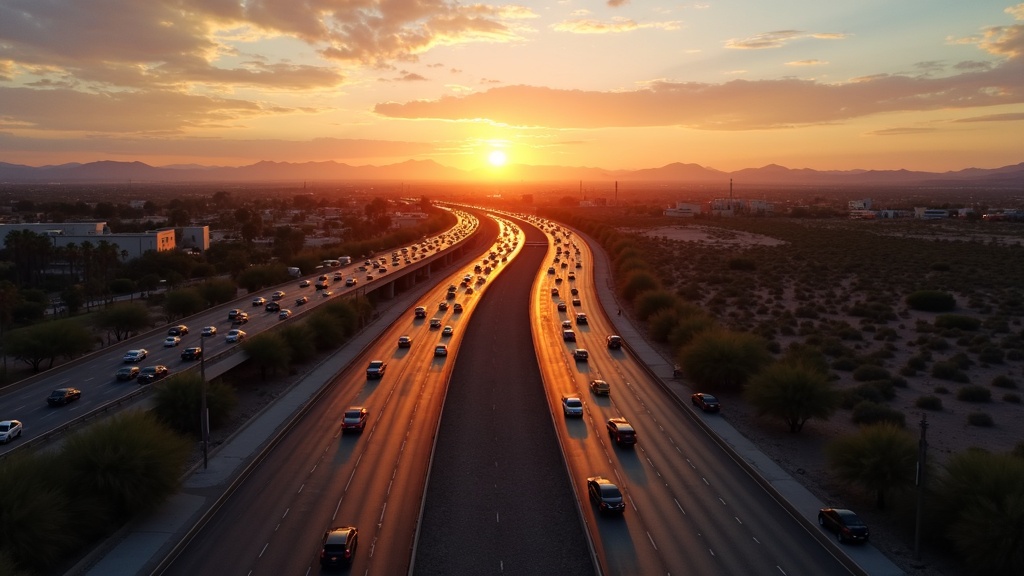
Why Loop 101 Crashes Are Different
The Agua Fria, Pima, and Price Freeways — the three segments that make up Loop 101 — carry distinct traffic patterns, design issues, and crash dynamics. A high-speed rear-end on the Pima 101 near Scottsdale is a different case than a multi-vehicle merge crash near the Glendale interchange. The legal framework is the same, but the evidence preservation, expert work, and demand strategy diverge significantly.
This page covers what specifically happens on the Loop 101 corridor, the Arizona law that controls fault and damages, and the moves to make in the first 72 hours after the crash.
The Three Loop 101 Segments and What Happens on Each
Agua Fria Freeway (I-10 to I-17)
The west-side segment connecting I-10 to I-17 sees heavy commuter density through Glendale, Peoria, and Surprise. Crash patterns concentrate around major interchanges, especially the I-17 system interchange and the 75th Avenue / Bell Road exits.
Pima Freeway (I-17 to Loop 202)
The north-east segment through Scottsdale and Phoenix. Higher speeds, heavier weekend traffic toward sports venues and entertainment districts. Multi-vehicle pileups during peak hours and Cardinals/Diamondbacks game traffic are recurring.
Price Freeway (Loop 202 to US-60)
The south-east segment through Tempe and Chandler. Tech corridor commuter traffic, high merge-and-weave density. Sideswipe and lane-change crashes dominate.
ARS 28-730 — Following Too Closely
The driver of a vehicle shall not follow another vehicle more closely than is reasonable and prudent, having due regard for the speed of the vehicles, traffic, and condition of the highway. This is the statutory anchor for most Loop 101 rear-end cases.
The Three Crash Types You’re Most Likely In
| Crash Type | Where on Loop 101 | Legal Anchor |
|---|---|---|
| Rear-end at congestion point | Approaches to interchanges, evening commute | ARS 28-730 following too closely |
| Lane-change / sideswipe | Pima segment merge-heavy zones | ARS 28-754 lane change safety |
| Multi-vehicle pileup | Sudden congestion + driver distraction | Comparative fault per ARS 12-2505 |
The Comparative Fault Reality on the Loop 101
Arizona follows pure comparative fault under ARS 12-2505. In a multi-vehicle pileup, fault is rarely 100% on one driver. The lead vehicle that stopped suddenly may share fault. The driver three cars back who failed to maintain following distance carries some. Insurers know this and use it. The leverage in a Loop 101 case often comes from documenting the specific actions of each driver before the crash — phone records, dashcam footage from third-party drivers, expert reconstruction.
The 14-Day Window for Crash Evidence on the 101
Loop 101 has ADOT camera coverage at most major exits. The footage is overwritten on a rolling 14-day cycle. If your crash was captured, a preservation letter must go out within 14 days or the evidence is permanently lost.
What to Do in the First 72 Hours After a Loop 101 Crash
Get the ADOT camera preservation letter out within 14 days
Standard preservation letter to ADOT identifying the exact mile marker, date, and time. Without this, the footage is gone in two weeks.
Document phone usage of the at-fault driver
Cell records can establish whether the at-fault driver was on their phone in the seconds before impact. These records are obtainable through legal process, not voluntary disclosure.
Pull dashcam footage from witnesses
Roughly 1 in 5 vehicles on Loop 101 has a dashcam. Witnesses who stopped at the scene may have footage that doesn’t appear in the police report.
Document delayed injuries
Head, neck, and back injuries from highway-speed crashes routinely surface 24-72 hours after impact. Establishing the medical record early protects against the “your injuries aren’t from the crash” defense.
Don’t give a recorded statement to the at-fault driver’s insurer
The at-fault driver’s insurer will call within 48 hours. Recorded statements at this stage are used to construct comparative-fault arguments later.
Frequently Asked Questions
How long do I have to file a claim after a Loop 101 crash?
What if multiple drivers caused the pileup?
Are Loop 101 crashes worth more because they’re highway-speed?
What if the at-fault driver doesn’t have enough insurance?
Should I call my insurance before a lawyer?
Loop 101 Crash? Time-Sensitive Evidence Disappears Fast.
ADOT camera footage overwrites in 14 days. Phone records become harder to subpoena over time. The window for a strong case starts closing the moment you leave the scene.